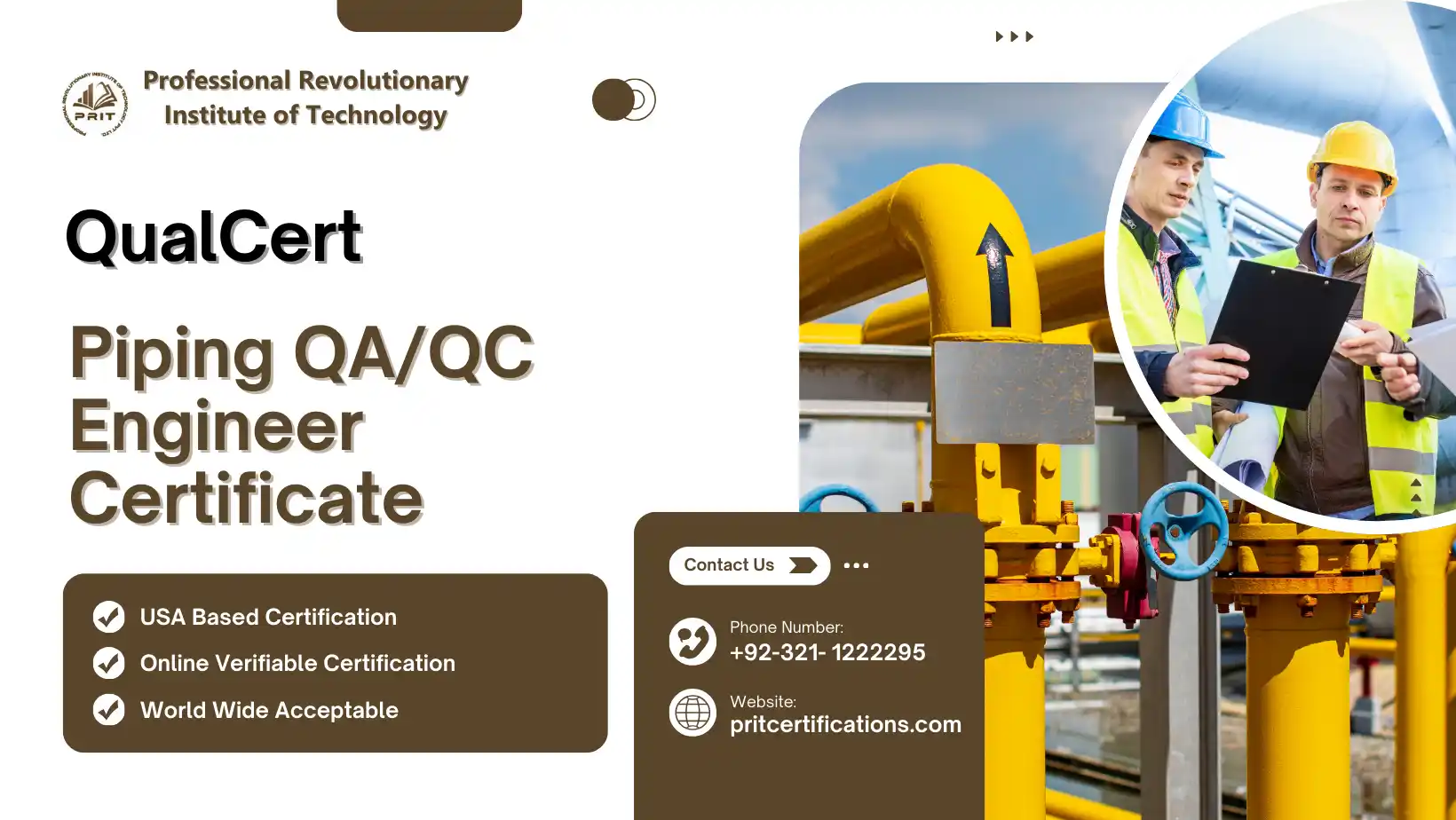
The QualCert Piping QA/QC Engineer Certificate is an internationally recognized qualification designed for professionals aspiring to build expertise in piping quality assurance and quality control. As industries such as oil and gas, petrochemical, power plants, and construction continue to expand globally, the demand for skilled QA/QC engineers has grown significantly. This program equips learners with comprehensive knowledge and practical skills to ensure that piping systems are designed, fabricated, installed, and tested according to international quality and safety standards.
The course covers essential aspects of piping engineering, including material inspection, welding quality, fabrication, erection, non-destructive testing (NDT), hydrostatic testing, and compliance with regulatory codes. It also emphasizes quality assurance principles, documentation practices, and adherence to health, safety, and environmental (HSE) standards.
By undertaking this certificate, learners gain the technical capability to monitor project quality, detect non-conformities, and recommend corrective actions effectively. They will be prepared to handle critical inspection responsibilities while ensuring that all processes align with global standards. Whether you are a beginner or a practicing professional, this certification provides the foundation for a rewarding career in piping QA/QC engineering.
Course Overview
Qualification Title: QualCert Piping QA/QC Engineer Certificate
Regulated by: QualCert
Guided Learning Hours (GLH): 180 hours
Credits: 40
Level: International Professional Certification
Mandatory Study Units
- Fundamentals of Piping QA/QC Engineering
- Piping Materials, Components, and Dimensional Inspection
- Welding Techniques, Symbols and Weld Quality Inspection
- Piping Fabrication, Installation & Erection Standards
- Non-Destructive Testing (NDT) and Hydrostatic Testing
- Quality Assurance, Documentation, HSE & Regulatory Codes
Learning Outcomes
Upon successful completion of this course, learners will be able to:
- Fundamentals of Piping QA/QC Engineering
- Understand the roles and responsibilities of a QA/QC Engineer.
- Apply quality assurance and control methodologies to piping projects.
- Implement international QA/QC frameworks for effective monitoring.
- Piping Materials, Components, and Dimensional Inspection
- Identify and verify piping materials and components as per specifications.
- Conduct dimensional inspections to ensure compliance with engineering drawings.
- Detect material defects and ensure traceability.
- Welding Techniques, Symbols and Weld Quality Inspection
- Interpret welding symbols and procedure specifications.
- Inspect welds for cracks, porosity, or defects using international codes.
- Verify welding compliance with industry standards and regulations.
- Piping Fabrication, Installation & Erection Standards
- Monitor fabrication and erection processes to ensure alignment with QA/QC requirements.
- Inspect piping alignment, supports, and installation quality.
- Ensure compliance with safety and performance standards.
- Non-Destructive Testing (NDT) and Hydrostatic Testing
- Apply NDT techniques such as radiographic, ultrasonic, and dye penetrant testing.
- Conduct hydrostatic pressure tests to evaluate system integrity.
- Interpret test results and recommend corrective actions.
- Quality Assurance, Documentation, HSE & Regulatory Codes
- Develop and maintain QA/QC documentation and records.
- Apply HSE practices in QA/QC inspection environments.
- Ensure compliance with international codes, regulations, and industry standards.
Entry Requirements
- A minimum Level 3 or 4 qualification in engineering, mechanical, or technical discipline, or equivalent work experience.
- Good understanding of industrial safety and engineering basics.
- English proficiency in reading, writing, and communication.
- Prior experience in oil & gas, petrochemical, or construction is preferred but not mandatory.
Course Benefits
- Gain an internationally recognized QA/QC engineering certification.
- Develop expertise in inspection, quality control, and piping project compliance.
- Enhance employability in industries like oil & gas, power plants, and petrochemicals.
- Acquire hands-on knowledge in NDT, welding inspection, and documentation control.
- Learn to maintain HSE standards alongside quality monitoring.
- Advance career opportunities globally with a specialized qualification.
Why Choose This Course?
- Awarded by QualCert, a respected international awarding body.
- Structured with theory and practical inspection-based modules.
- Recognized globally for QA/QC professionals.
- Provides a solid foundation for advanced certifications in QA/QC and NDT.
- Tailored to meet international industry demands for piping quality engineers.
Who Can Enroll in This Course?
This certificate is suitable for:
- QA/QC Engineers and Inspectors.
- Welding inspectors and NDT technicians.
- Piping and mechanical engineers.
- Quality control supervisors and managers.
- Professionals in oil & gas, petrochemical, and construction sectors.
- Graduates aspiring to start a career in QA/QC engineering.
Future Progression
After completing this course, learners can progress to:
- Advanced QA/QC Engineering Certifications in piping and welding.
- Specialist NDT qualifications (Level II & Level III).
- Lead Auditor courses for ISO quality management systems.
- Managerial positions in QA/QC and project quality departments.
- International consultancy roles in inspection and quality engineering.